Belvedere, Kent
| Belvedere | |
| Kent | |
|---|---|
 All Saints Church | |
| Location | |
| Grid reference: | TQ495785 |
| Location: | 51°29’8"N, -0°9’15"E |
| Data | |
| Population: | 11,890 (2011) |
| Post town: | Belvedere / London |
| Postcode: | DA17 / SE2 |
| Dialling code: | 020 |
| Local Government | |
| Council: | Bexley |
| Parliamentary constituency: |
Erith and Thamesmead |
Belvedere is a town in suburban Kent. It lies close to the River Thames, with Erith to the east, Bexleyheath to the south, and Abbey Wood and Thamesmead to the west.
History
The area which is today known as Belvedere was for centuries part of Lessness Heath,[1] the eastern parts of a narrow high ridge which stretches from the area of Lesnes Abbey to Erith. The northern stretch is industrial and environmental and was common meadow.
In 1847 this largely uncultivated, wooded estate, almost undivided was given by operation of the will of last Lord Saye and Sele to his cousin Sir Culling Eardley, who built properties in Belvedere until his death in 1863. Eardley constructed a large wooden tower on the heath to gain views over his estate to the River Thames: the tower, a 'belvedere' (from the Italian "beautiful view") gave a name to the village which grew up here. The place still has commanding views from the ridge, towards Canary Wharf and London.
Eardley was persuaded to allow the construction on his property, of a Dissenters' chapel, which was built so that the original wooden belvedere became its tower. In order that the public were able to attend this chapel, he constructed paths to it across Lessness Heath. Eardley had finished in 1861, after nearly 8 years of building, his chapel, now All Saints' Church, after the earlier chapel with belvedere burned down on the same site.[2] At the same time Eardley constructed Villa Houses and reinforced the heath path to become Erith Road. Belvedere village soon grew up along the path which became Bexley Road (from March 1939 known as Nuxley road after the small heath located 1 km south) as Eardley gradually sold off the land.
At about 6.40 am on Saturday 1 October 1864, there was a massive explosion which totally destroyed two commercial gunpowder factories, situated in isolation on the Belvedere side of Erith Marshes, along with their store magazines and a couple of barges that were being loaded with barrels of gunpowder at the time. The explosion was heard over a 50 miles radius, and the shock wave was so intense that people in central London were convinced that there had been an earthquake. One report at the time said that as rescuers hurried to the site they found a massive crater and absolutely no signs of any buildings were left “it was if the place had been swept clean by a broom”. There were only around twenty casualties, as though the explosion was huge, the remote location prevented greater loss of life.[3]
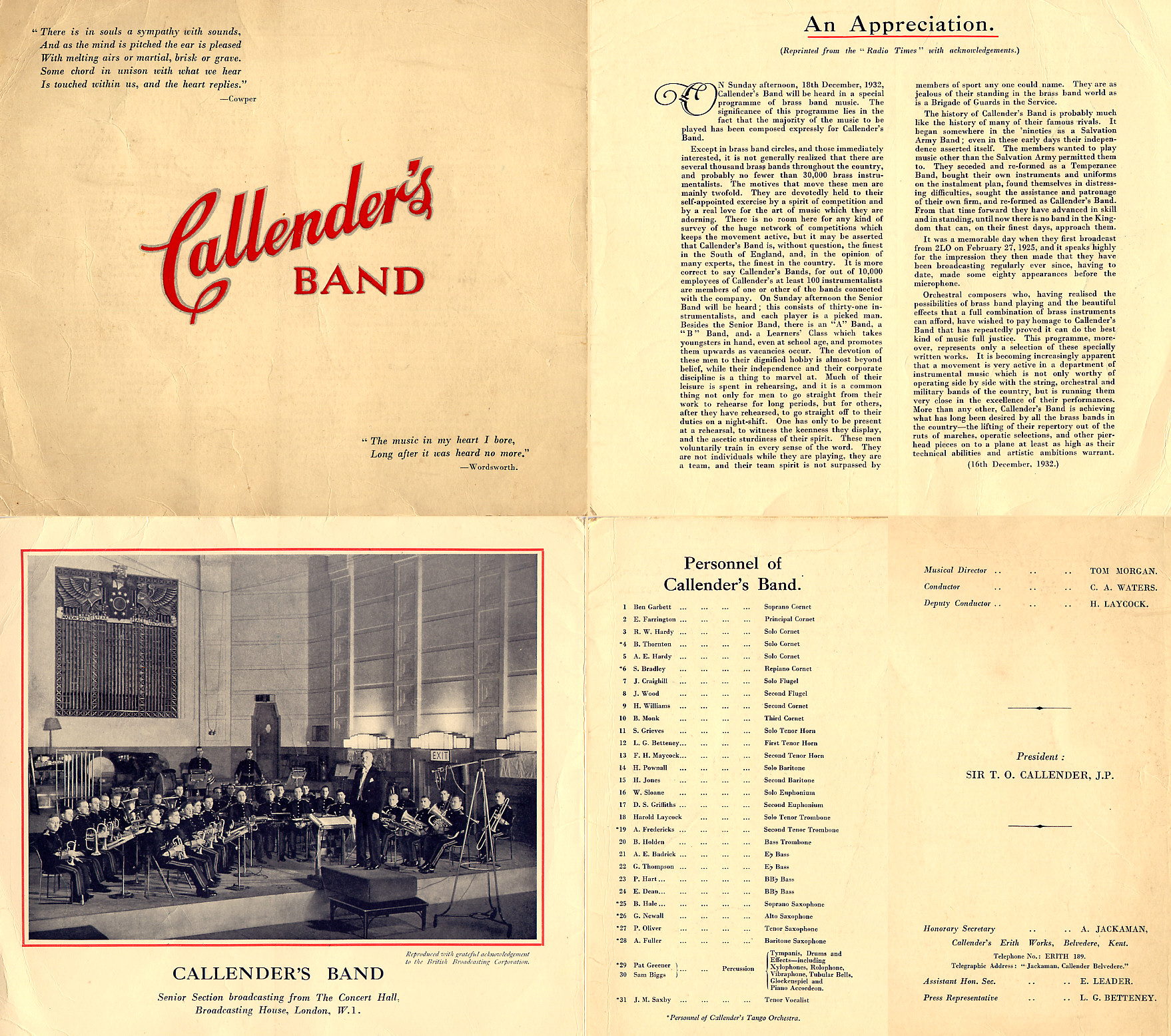
Development took place before the Second World War, with significant reconstruction after the Blitz. Despite this, Upper Belvedere and The Village still retains much of its Victorian and Edwardian charm and character. Between 1898 and 1961, Callender's Cable Works, at the Erith Works, Belvedere, was patron to Callender's Cableworks Band, an amateur brass band made up of employees of the company. The band was a prolific broadcaster on BBC Radio in the 1920s and 1930s.[4]
In 1953, the North Sea Flood of that year hit the area of Belvedere Marshes badly, leaving the 1,700 gypsies who lived there with nothing. One person died in the flooding and hundreds had their homes damaged. Queen Elizabeth II came to visit the communities of Erith and Belvedere, who were without electricity for weeks, to pay her respects.[5]
There has been a lot of controversy with local residents over recent years about the correct name of the "village" area of Belvedere incorporating the triangle of Nuxley Road, Albert Road, and Woolwich Road. Council road signs call it Belvedere Village, maps and the post office list the area as Belvedere, but some locals call it Nuxley Village after the road. Many residents informally call the area "The Village". The origins of 'Nuxley Village' is believed to come from estate agents upselling the area.
Landmarks

Upper Belvedere has a fine church and some fine Victorian and Edwardian brick villas. It has a number of fine pubs, restaurants and retail outlets: The Eardley Arms and the Prince of Wales on Woolwich Road, The Victoria on Victoria Street, The Royal Standard, The Village Inn (formerly the Queens Head) and The Fox all on Nuxley Road. Upper Belvedere is also home to a large park and a branch library that was in danger of being closed due to central government funding cuts. Fortunately closure threats were averted as a result of the efforts of the local community. A "Splash Park" (opened in 2005, closed in 2016) was a welcome addition to the village, having been developed on the site of the old Victorian paddling pool. The Splash Park retained some of the original paddling pool structures. The Splash Park was closed in 2016 and replaced with a new play area called Belvedere Beach; this opened on 27 July 2017.
Lower Belvedere is smaller than Upper Belvedere, more industrial and closer to Belvedere railway station. It has a Methodist chapel and a Sikh Temple. To its north it borders Crossness, an area near the Thames containing a small industrial park, Belvedere Incinerator (a large waste-to-energy plant), and Crossness Sewage Treatment Works with its high technology sludge methane incinerator[6] and Joseph Bazalgette's Victorian Crossness Pumping Station.
The Grade II Listed Bexley College was designed in 1906 by W Egerton in the Queen Anne style and is on residential Erith Road on the last part of the ridge, in the east of the district on the border of Erith.[7]
Churches and other places of worship
- Church of England:
- All Saints Belvedere, Nuxley Road
- St Augustine, Belvedere
- Baptist:
- Belvedere Baptist Church
- Free Grace Baptist Church, Nuxley Road
- Congregationalist: Belvedere Congregational Church, Picardy Road
- Independent / evangelical: Ichthus Community Church, Belvedere
- Methodist: Belvedere Methodist Church
- Pentecostal: Belvedere Pentecostal, Mitchell Close
Sikhs
- Guru Nanak Darbar, Sikh Temple, Mitchell Close
Sport
- Cricket Club: Belvedere Cricket Club, which plays at Memorial Sports Ground
- Football:
- Erith & Belvedere F.C.
- Belvedere F.C.
- Hockey: Bexleyheath and Belvedere Hockey Club (based in Welling)
Green Chain Walk
The Green Chain Walk is largely east–west route along the northern slopes of the ridge, stretching from Plumstead Common to Erith, it provides a shortcut to the Thames Path - to which it is linked in three locations.
Outside links
References
- ↑ Lenham - Levens: 'A Topographical Dictionary of England'; Samuel Lewis
- ↑ National Heritage List 1064197: All Saints' Church (Grade II listing)
- ↑ "Erith Fun Day.". 31 August 2014. http://arthurpewtysmaggotsandwich.blogspot.co.uk/2014/08/erith-fun-day.html.
- ↑ Callender's Band performance programme or handout leaflet, 16 Dec 1932
- ↑ Cottle, Robin. "Remembering the Belvedere floods, 60 years on" (in en). Bexley Times. http://www.bexleytimes.co.uk/news/remembering-the-belvedere-floods-60-years-on-1-1805709.
- ↑ Bond, Sam (16 June 2006). "Green light for super incinerator". https://www.edie.net/green-light-for-super-incinerator/.
- ↑ National Heritage List 1387547: Bexley College (Former Erith Technical Institute) including attached walls, railings and gatepiers (Grade II listing)